
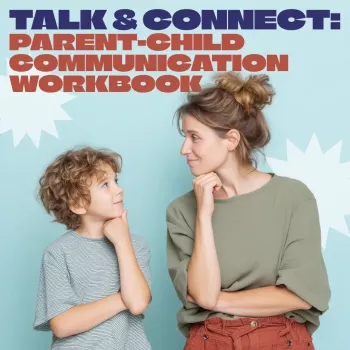
Consistent, caring conversations help children feel seen, safe, and supported—especially during busy, emotionally charged seasons of family life. A workbook-style approach makes connection easier to start and easier to repeat, so communication doesn’t depend on having the “perfect” words at the perfect time. If your family could use a calmer rhythm for talking things through, Talk & Connect: Parent-Child Communication Workbook offers simple prompts, practical exercises, and parent-friendly tools that build trust and everyday emotional closeness.
Many parents care deeply and still find conversations slipping into stress, silence, or power struggles. Common roadblocks often look like:
It can help to remember: struggling to communicate usually isn’t a lack of love—it’s a lack of bandwidth and a lack of repeatable tools.
A workbook doesn’t replace your relationship; it supports it with structure. Instead of improvising conversation starters when everyone’s tired, a guided page gives you something concrete to do together.
For evidence-based guidance on positive, steady parenting approaches, resources like the American Academy of Pediatrics’ Positive Parenting Tips and the CDC’s Essentials for Parenting reinforce the value of predictable connection, calm follow-through, and age-appropriate communication.
Some tools are meant for “big talks.” This one is meant for everyday life—small moments that strengthen the baseline of trust.
| Skill to practice | What it can sound like | Why it matters |
|---|---|---|
| Reflective listening | “It sounds like that really disappointed you.” | Kids feel understood and are more likely to keep talking. |
| Open-ended questions | “What was the best and hardest part of today?” | Encourages details and emotional insight beyond yes/no. |
| Emotion coaching | “It’s okay to be mad. What can help right now?” | Builds self-regulation and reduces explosions over time. |
| Conflict repair | “I didn’t handle that well. Can we try again?” | Models accountability and restores closeness after tension. |
| Collaborative problem-solving | “What ideas do you have so mornings go smoother?” | Increases cooperation and reduces repeated battles. |
Kids can sense when a parent is “trying to get a confession.” Keeping it light and predictable makes sharing more likely.
If your child opens up best while doing something with their hands, pairing prompts with a low-pressure activity can help. A simple, playful option like the Children’s Ice Cream Stacking Game can create side-by-side moments where conversation flows more naturally.
Consistency matters more than intensity. A gentle progression keeps things realistic and prevents the “we did it twice and quit” cycle.
Over time, this kind of steady connection supports resilience—an ability to recover from setbacks and manage stress. For additional reading, the American Psychological Association’s guide to building resilience offers practical, developmentally aware ideas.
For families who want a ready-to-use structure, Talk & Connect: Parent-Child Communication Workbook can be used in short check-ins a few times per week—enough to build momentum without adding stress.
It’s flexible across ages: younger kids do best with shorter prompts and either/or choices, while older kids and teens respond best to respect, privacy, and collaborative questions. The same skills—listening, validation, and repair—can be adapted to any stage.
Small, consistent routines tend to work best—about 5–10 minutes a few times per week. Progress is usually gradual, but steady check-ins often create a noticeably warmer baseline over time.
Keep it low-pressure: try side-by-side conversations, allow a “pass,” and use fewer questions with more reflections of what you notice. Start with neutral topics and come back later after everyone is calm.






Leave a comment