
Fear of failure rarely announces itself as fear. More often it shows up as procrastination, perfectionism, overthinking, or quitting early—sometimes disguised as “being realistic.” The turning point comes when failure stops feeling like a verdict about who you are and starts functioning like feedback about what you tried. With a few repeatable practices, confidence becomes less of a mood and more of a result: you build it by collecting small wins, learning fast, and continuing on purpose.
Fear can feel logical because it borrows your brain’s threat-detection system. When uncertainty rises—especially where others might judge the outcome—avoidance can seem like the safest move, even if the goal matters deeply.
One useful anchor is the idea of growth mindset: skills aren’t fixed traits—they can improve with practice and feedback. The American Psychological Association summarizes why believing you can improve changes how you respond to setbacks (APA—growth mindset).
Fear tends to repeat itself through predictable habits. The good news: once a pattern is visible, it’s adjustable.
| Pattern | Hidden payoff | Replacement behavior |
|---|---|---|
| Perfectionism | Avoids judgment by never finishing | Define a “good enough” threshold and ship a draft |
| Procrastination | Avoids discomfort now | Start a 10-minute “messy first step” timer |
| Over-preparing | Avoids the risk of real feedback | Do a small test with a clear success metric |
| Self-sabotage | Protects ego from full-effort failure | Commit to a realistic plan and track inputs, not outcomes |
| All-or-nothing thinking | Simplifies complex progress into a single label | Use a 0–10 progress scale and note one improvement |
The fastest way to reduce fear is to change what failure “means.” When it stops being a character judgment and becomes information, you can stay in motion long enough to improve.
If you like structured tools for thought patterns, Cognitive Behavioral Therapy (CBT) is widely used for noticing unhelpful beliefs and choosing more workable responses (NIH overview of CBT).
Confidence grows from evidence. This one-week reset focuses on small, repeatable actions that create proof you can follow through.
This approach aligns with self-efficacy: confidence that you can execute the actions needed to reach a goal. Self-efficacy strengthens through practice, feedback, and achievable challenges (Britannica—self-efficacy).
Fear spikes are normal. The goal isn’t to eliminate them—it’s to keep the next step so clear and small that you can take it anyway.
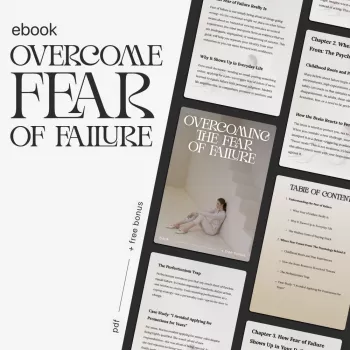
If you want a structured, step-by-step approach with exercises you can repeat, Overcoming the Fear of Failure (Digital eBook) focuses on practical reframes, prompts, and habits that build confidence through action.
No. Fear of failure can show up even when skills are strong; it often spikes when the outcome feels tied to identity or judgment. Confidence grows from evidence built through repetition and feedback, not from avoiding risk.
High standards are about quality; perfectionism is rigid rules that prevent progress. Set a “good enough” threshold, time-box drafts, and improve through iterations so quality rises without requiring a flawless first attempt.
Legitimate risk deserves planning. Reduce exposure with small tests, backups, and clear contingencies, then focus on controllable inputs (preparation, reps, and timelines) so you’re improving the process even when outcomes matter.






Leave a comment