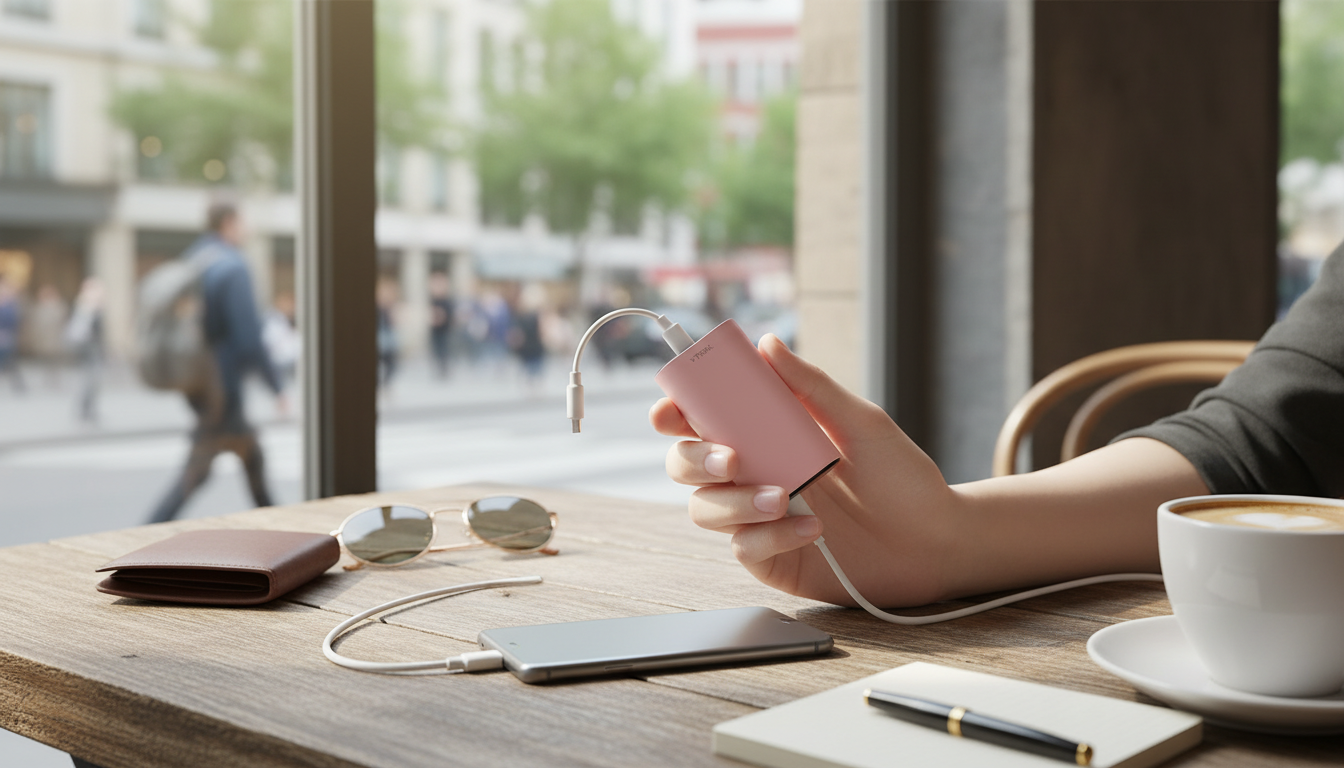
A compact portable power bank is a practical way to keep a phone, earbuds, or other small USB-powered devices running when outlets aren’t available. It’s the kind of accessory that earns its keep in everyday moments—when a battery dips low right before a meeting, during a delayed commute, or while navigating a new city. Below are the essentials to know before buying, plus realistic charging expectations and simple safety habits for daily carry.
A small power bank acts like a mobile wall outlet for USB-powered devices. When your phone is running low and a plug isn’t available, it provides backup power so you can keep texting, calling, navigating, paying, and scanning tickets without scrambling for an outlet.
It’s ideal for extending day-to-day battery life during long commutes, conferences, concerts, and travel days—especially when your phone is doing “heavy work” like GPS navigation, video calls, or hotspot use.
That said, compact models are designed for small electronics. They are not meant to power high-draw appliances, and they won’t reliably charge laptops unless the unit explicitly supports the needed wattage and USB-C power delivery profiles.
Also keep in mind that real-world performance varies. Capacity ratings are measured under controlled conditions, but results depend on conversion efficiency, cable quality, the device being charged, and even temperature. Charging speed is limited by both the power bank’s output and the receiving device’s input—whichever is lower becomes the bottleneck.
A quick top-up can be the difference between finishing a ride-share pickup, keeping navigation active, and still having enough battery for calls and mobile payments.
Airports, train stations, and long sightseeing days can drain a phone fast—especially when photos, translation apps, and maps are constantly in use. A pocket-size charger is an easy backup during layovers and day trips.
Phones often double as security keys for two-factor authentication, hotspots, and collaboration calls. A compact power bank can keep you connected through long meetings or unexpected late-day tasks.
From headphones to GPS accessories, small USB devices are common companions outdoors. A power bank offers emergency charging when outlets are far away.
For a go-bag, a small power bank paired with a short cable and compact flashlight is a low-effort upgrade. For air travel, it’s also worth reviewing official carry-on guidance for lithium batteries from the FAA and the IATA.
| Need | What to prioritize | Why it matters |
|---|---|---|
| Pocket-friendly daily carry | Smaller size and lighter weight | More likely to be carried and used consistently |
| Fast top-ups | Higher output and fast-charge compatibility | Reduces time tethered to a cable |
| Charging two devices | Multiple outputs and stable total power | Avoids slowdowns and interruptions |
| Travel convenience | Broad device compatibility and reliable protections | Supports varied devices and reduces risk |
| Emergency backup | Higher capacity and sturdy build | Longer runtime and better resilience |
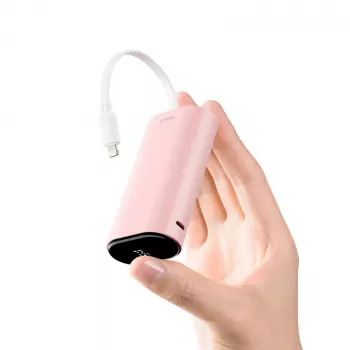
If you want a straightforward backup option for everyday charging, the Compact Portable Power Bank is a practical daily-carry accessory for home, work, and on-the-go use. It pairs well with a short, durable cable kept in a bag or jacket pocket so you’re ready for quick top-ups when your battery drops unexpectedly.
It depends on the power bank’s capacity, your phone’s battery size, and normal conversion losses. As a rule of thumb, the usable energy is often meaningfully less than the rated capacity, so expect fewer full recharges than a simple “capacity divided by capacity” estimate.
Many power banks and phones include built-in protections and charge management, but overnight charging is safest when the bank is on a hard, ventilated surface away from blankets or heat sources. If you notice unusual heat, swelling, or a chemical smell, stop using the power bank immediately.
Common causes include a weak wall adapter when recharging the bank, a low-quality or damaged cable, your phone limiting input power, multiple devices connected at once, or the power bank being nearly empty. Try a different cable first, then test another adapter/port, and finally try charging a different device to pinpoint the bottleneck.






Leave a comment