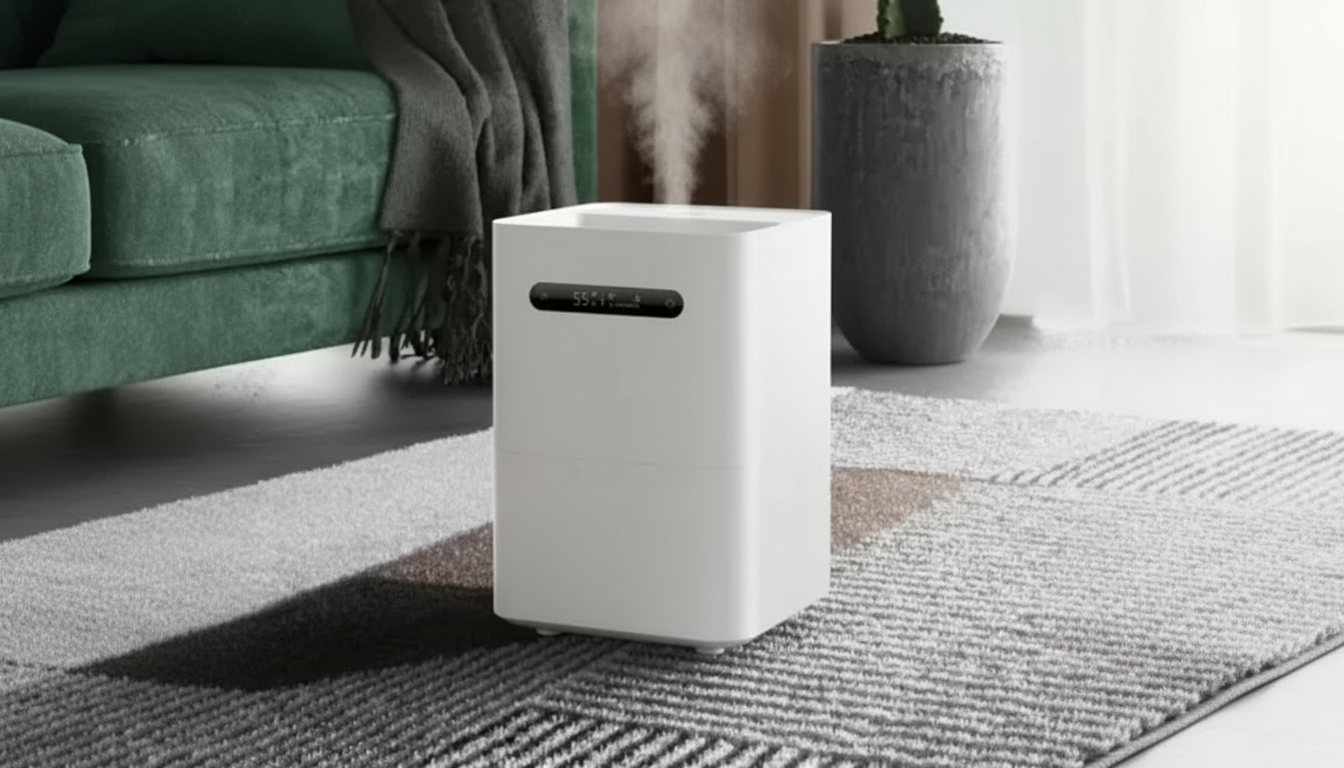
Balanced indoor humidity can improve comfort, protect wood furnishings, and help reduce dryness during seasonal heating or air conditioning. This 4L evaporative humidifier pairs natural evaporation with app-based controls for hands-off, room-by-room moisture management—helping you stay comfortable without constantly checking the tank or guessing at settings.
Evaporative humidifiers work with a simple, steady principle: a wick (or filter) absorbs water, and a fan moves air across it so moisture naturally evaporates into the room. Because evaporation is influenced by the room’s current humidity, this approach can feel more “self-balancing” than some mist-based designs.
As indoor air becomes more humid, it can’t absorb water as quickly—so the evaporation rate naturally slows. That doesn’t eliminate the need to monitor humidity, but it can reduce the chance of pushing a room into an overly damp range.
In many homes, humidity swings as HVAC cycles on and off or outdoor weather changes. Evaporative output tends to follow the air’s demand for moisture, which can support a more consistent feel across the day.
Evaporative systems typically require periodic wick care (cleaning or replacement) to keep performance strong and odors down. You’ll also want enough clearance for airflow, and fan sound will vary by speed setting—something to consider for bedrooms and nurseries.
App control turns humidity into something you can manage like lighting or temperature: adjust it from the couch, the office, or upstairs—without walking to the unit.
With app access, it’s easy to set a target humidity, change fan levels, or power the unit on/off when the room feels dry. That’s especially useful for multi-level homes or busy evenings when routines shift.
Helpful reminders—like water level notifications or wick-care prompts—can prevent performance dips. For the smoothest connection, keep the humidifier within reasonable Wi‑Fi range and confirm your router settings are compatible with the device’s requirements.
Place the unit with a little clearance on all sides so intake and outlet airflow aren’t blocked. Avoid tight corners and direct heat sources (like radiators or sunny windowsills), which can skew readings and change evaporation behavior.
A 4L tank is designed to cut down on refill frequency—particularly during winter heating season or in dry, air-conditioned climates. Less refilling can also make it easier to maintain consistent overnight comfort.
Actual run time depends on fan speed, room size, temperature, and how dry the air is to begin with. A practical routine is to top up before bedtime and observe how much water is used after the first few nights; that real-world pattern is the best guide for your home.
| Factor | Typical impact | What to do |
|---|---|---|
| Higher fan speed | Faster evaporation and more frequent refills | Use higher speed for quick relief, then step down to maintain |
| Larger room or open floor plan | More moisture demand | Place centrally and consider closing doors to focus on one room |
| Warm indoor air | Can increase evaporation | Monitor humidity and avoid overheating the room |
| Already-humid environment | Slower evaporation | Lower fan speed; rely on natural self-regulation |
If your app reports humidity, it can be a convenient guide. In larger spaces, it’s smart to confirm with a separate hygrometer in the area where people actually spend time. For more on moisture control and preventing mold, see the EPA’s guidance on moisture control and mold and ASHRAE’s resources on indoor air quality.
Evaporation naturally slows as humidity rises, which can make it harder to overshoot compared with some constant-output approaches. It’s still wise to monitor humidity with a hygrometer (or confirm app readings) to stay in a moderate range and avoid condensation.
It depends on fan speed, room size, temperature, and how dry the air is. A simple approach is to run your normal settings for 2–3 days and note the refill pattern, then adjust speed or schedule to match the results you want.
Empty and rinse regularly, follow a consistent cleaning routine, and service the wick/filter on schedule. Avoid letting water sit stagnant for extended periods, since that’s a common cause of odor and performance issues.


Leave a comment