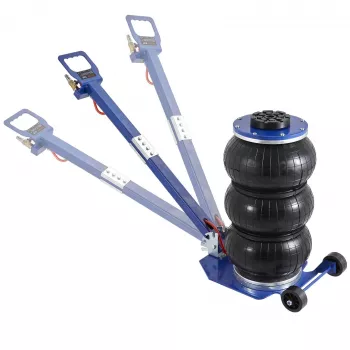
A triple-bag pneumatic air jack is built for fast, low-effort lifting in garages, driveways, and shop bays where an air compressor is available. With a 3-ton capacity, rolling wheels, and a long handle for positioning, this style of jack is designed to get under vehicles quickly and raise them with controlled air pressure—while keeping setup and safety practices front and center.
A triple-bag pneumatic air jack uses compressed air to inflate stacked air bags that raise a lift pad vertically. Compared with a traditional hydraulic floor jack, the “muscle” comes from air pressure rather than a pumping handle, which can make repeated lifts feel noticeably easier during a busy day.
This type of jack fits best for quick service tasks like tire changes, brake inspections, suspension checks, and fast underbody access—especially when a compressor is already part of the workflow. The triple-bag layout is also popular because it can reach a useful working height while keeping a broad, stable footprint on the ground.
The integrated wheels and long handle are practical in real-world bays and driveways. They help guide the jack under side skirts or toward frame rails with less crawling and less dragging on the surface. Common users include home mechanics, tire shops, and mobile service setups that carry a compressor.
Knowing the main components makes setup faster and helps catch issues before they become safety problems:
| Component | What to look for | Action if an issue is found |
|---|---|---|
| Air hose connection | No leaks, secure fitting | Tighten/replace fitting; do not operate with leaks |
| Air bags | No cracks, bulges, or abrasion | Remove from service and replace bags/parts |
| Control valve | Smooth operation, predictable lowering | Service valve; avoid sudden drops |
| Lift pad | Centered, intact, not oily | Clean/replace pad; wipe contact area |
| Wheels and handle | No wobble, secure fasteners | Tighten hardware; confirm steering control |
A 3-ton (6,000 lb) rating is typically intended for lifting one end or one corner of many passenger vehicles when used correctly at approved lift points. Real-world suitability depends on how the vehicle’s weight is distributed and where the load is applied—corner weight can be higher than expected on some vehicles, and non-reinforced areas can flex or slip.
| Check | Why it matters | What to do |
|---|---|---|
| Vehicle jacking points | Prevents panel/frame damage | Use manufacturer lift points; avoid thin pinch seams unless specified |
| Surface quality | Stability depends on ground support | Use on level concrete when possible; avoid soft asphalt on hot days |
| Compressor capability | Determines speed and consistency | Confirm adequate pressure/flow; drain compressor moisture as needed |
| Stand placement plan | Jack is for lifting, stands are for holding | Position stands before lifting; lower onto stands smoothly |
For general shop safety practices, review guidance from OSHA’s Automotive Service Operations. For tire-change fundamentals and related safety reminders, the NHTSA Tire Safety resource is also a solid reference.
| Mistake | Risk | Better approach |
|---|---|---|
| Working under a vehicle supported only by the air jack | Severe injury if pressure drops or load shifts | Always use jack stands on solid points |
| Using on uneven or soft ground | Tipping, sinking, unstable load | Move to level concrete or use approved load-spreading support |
| Lifting at non-reinforced points | Vehicle damage, slip | Use manufacturer-recommended lift points |
| Over-raising beyond necessary height | Reduced stability, more stored energy | Lift only to the height needed for stand placement |
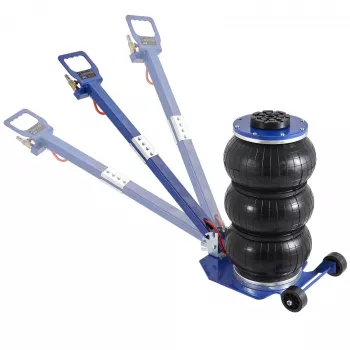
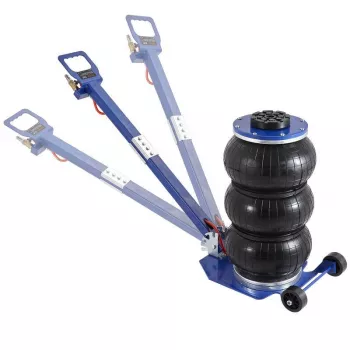
3 Ton Triple Bag Pneumatic Air Jack with Wheels & Long Handle is designed for rapid lifting using compressed air, with wheels and an extended handle to improve maneuverability. It’s a practical option for faster setup than manual jacking when an air supply is already available. Before use, confirm vehicle lift points, jack stand requirements, and compressor compatibility.
No. The jack is for lifting, not long-term support. Once the vehicle is raised, lower it onto properly rated jack stands placed on solid lift points before working.
Check the jack’s rated operating pressure on its label or documentation and match your setup to that requirement. Your compressor must provide both the needed pressure and enough airflow for steady lifting, with hose and fittings rated for the same pressure.
Only if the asphalt is firm, level, and not soft from heat. Soft asphalt can allow the jack to sink or shift, so solid concrete is preferred, or use approved load-spreading support if allowed by the manufacturer.




Leave a comment