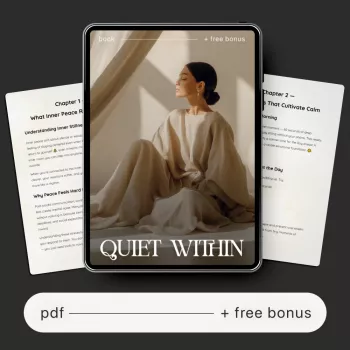
Modern life tends to reward speed, constant availability, and relentless self-criticism—conditions that make calm feel like a rare luxury. Quiet Within — A Practical eBook on how to find inner peace, Self-Compassion, Daily Calm Habits & Digital Mindfulness Guide is built around a simpler idea: inner steadiness comes from small, repeatable habits. Instead of waiting for life to slow down, it helps create a daily baseline through kinder self-talk, quick grounding routines, and healthier boundaries with screens.
Research continues to support mindfulness-based approaches for stress reduction and well-being, especially when practiced consistently and realistically. If you like a science-informed overview, the American Psychological Association and the National Institutes of Health (NCCIH) offer helpful summaries of evidence and safety considerations.
Inner peace doesn’t mean never feeling stressed. It means returning to center faster, with less self-judgment and fewer spirals. In practice, “quiet within” often shows up as:
Inner peace grows when thoughts and sensations can be noticed without instantly reacting to them. A brief pause—one breath, one check-in—creates room to choose what happens next.
Self-compassion isn’t “letting yourself off the hook.” It’s acknowledging that struggle is part of being human, then taking the next helpful step. It reduces the extra suffering created by harsh inner commentary.
Consistency usually beats intensity. A small morning cue, a midday reset, and an evening wind-down can become reliable “bookends” for your nervous system—especially on high-demand days.
Mindful tech use focuses on cues, limits, and friction where it helps: fewer alerts, clearer boundaries, and fewer automatic checks. The goal is to reclaim attention without guilt or extreme rules.
The simplest wins often come from stacking habits. For example: one slow breath before opening a social app, or a two-minute stretch before answering messages. Tiny transitions are powerful.
To make calm more repeatable, start small enough that resistance stays low. Pair each practice with an existing cue (kettle boiling, logging in, brushing teeth). Track one signal only—stress level, sleep quality, or screen time—so it stays realistic. If you miss a day, restart at the next cue; no catch-up required.
| Day | Focus | Practice | Time | Optional digital boundary |
|---|---|---|---|---|
| Day 1 | Awareness | 3 slow breaths + name the feeling | 2 min | Turn off non-essential notifications for 24 hours |
| Day 2 | Self-compassion | Replace self-criticism with one supportive sentence | 3 min | No phone in the bathroom |
| Day 3 | Body calm | Progressive muscle release (shoulders, jaw, hands) | 5 min | Move social apps off the home screen |
| Day 4 | Thoughts | Write a “worry list,” then circle what’s controllable | 7 min | Set a 15-minute timer for scrolling |
| Day 5 | Boundaries | Choose one “not now” response and use it once | 5 min | Stop checking email after a chosen hour |
| Day 6 | Gratitude + grounding | List 3 small wins + 5-4-3-2-1 senses check | 8 min | No screens during the first 10 minutes after waking |
| Day 7 | Review | Note what helped most; plan the next 7 days | 10 min | Schedule one screen-free block on the calendar |
For an evidence-backed boost to mood and perspective, a brief gratitude practice can help; Harvard Health Publishing summarizes benefits and practical ways to begin in Practicing gratitude (and its benefits).
If you want a structured guide you can return to in minutes, Quiet Within is designed for quick resets and repeatable routines—especially when time and energy are limited. The emphasis stays on small changes that compound: a calmer baseline, more supportive self-talk, and digital boundaries that protect attention without requiring an all-or-nothing approach.
To make those routines easier to practice, a calm physical environment can help reduce “visual noise.” If you like setting up a simple reset station (journal, tea, timer, book), the Luxury 12-Inch Stainless Steel Decorative Tray for Home, Kitchen & Countertop is a practical way to keep a small, consistent space for daily wind-down or morning grounding.
Some people notice smoother transitions and fewer stress spikes within a few days, especially with consistent 2–5 minute practices. Deeper change usually comes from repeating small routines for a few weeks while tracking one simple signal such as sleep quality or stress level.
No. Digital mindfulness focuses on intentional use—adjusting notifications, adding timers, changing app placement, and scheduling screen-free blocks—so social media supports your goals rather than hijacking attention.
That’s common. Start with neutral, believable language and pair it with one supportive action (drink water, take two breaths, write the next step); comfort grows through repetition, not perfect wording.






Leave a comment