
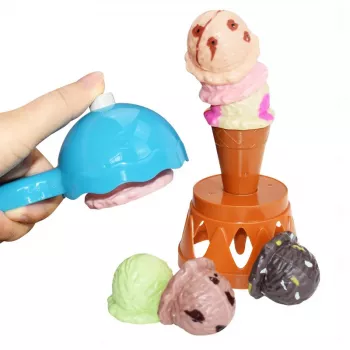
Bright, scoop-shaped pieces and a simple stacking challenge turn playtime into a hands-on way to practice balance, patience, and coordination. An ice cream stacking set works well for quick solo challenges, sibling turn-taking, or small-group party games—without screens or complicated setup. If you’re looking for a compact activity that’s easy to bring to the kitchen table, a classroom center, or a weekend playdate, the Children’s Ice Cream Stacking Game is a fun, low-fuss choice.
At its core, an ice cream stacking game is a balancing tower challenge with a pretend-play twist. Kids build a tower by stacking “ice cream” pieces (often in different colors and shapes) on top of a base, trying to keep the whole stack stable as it gets taller.
Because the setup is minimal, it’s easy to turn this into a “one more round” game before dinner or a quick reset activity between homework and bedtime. For families that like variety, you can also pair playtime with music for a party vibe using something simple like a Portable Waterproof Bluetooth Speaker with TWS Pairing and LED RGB Lights—especially for timed challenges and group games.
Stacking games look simple, but they quietly support multiple developmental areas. Early childhood experts emphasize that play is a powerful way kids build real-world abilities; resources like NAEYC’s guidance on play and learning highlight how hands-on play supports cognitive, social, and emotional growth.
For parents tracking developmental progress, the CDC’s early childhood milestones offer helpful context for how skills like grasping, stacking, and coordination typically grow over time.
| Age range | Best way to play | Skills emphasized | Quick tip |
|---|---|---|---|
| 2–3 | Free stacking and pretend ice-cream shop | Grip, coordination, naming colors | Keep rounds short; celebrate any stable stack |
| 4–5 | Take turns adding one piece each | Patience, steady hands, rule-following | Use a “gentle hands” reminder before each turn |
| 6–8 | Timed tower challenge or pattern copying | Planning, speed + control, focus | Start with a wider base; build upward slowly |
Once kids understand how the pieces balance, the fun really opens up. Small rule tweaks keep the game fresh and let you match the challenge to the moment—calmer after-school play, higher-energy party rounds, or a quiet focus activity.
To add a little “real-life” learning, try giving kids three “orders” to remember (like “strawberry, mint, chocolate”) and let them build from memory. If the tower falls, they can problem-solve: Was the base too narrow? Was one scoop heavier or off-center? Over time, kids start making smarter building choices without being told.
A stacking game is typically straightforward, but a few small habits make play smoother and safer—especially with mixed ages in the same room.
For additional guidance on choosing and using toys safely, the American Academy of Pediatrics’ toy safety tips are a solid reference for families and caregivers.
If you want a small, budget-friendly pick for everyday play or a quick surprise, the Children’s Ice Cream Stacking Game is easy to wrap, easy to store, and easy to replay—without needing batteries, apps, or a long attention span.
It’s typically best for preschool through early elementary kids. Younger children can enjoy simple free stacking and pretend “ice cream shop” play, while older kids do well with turns, patterns, or timed challenges; close supervision is important for very young children who still mouth toys.
To make it easier, start with a wider base, use fewer pieces, and skip the timer. To make it harder, add a timer, build using only one hand, copy patterns, follow color restrictions, or start from a smaller base.
Yes—short rounds, quick resets, and simple turns make it easy for small groups. Set up on a stable table, use a timer for excitement, and consider team play to keep everyone involved.



Leave a comment