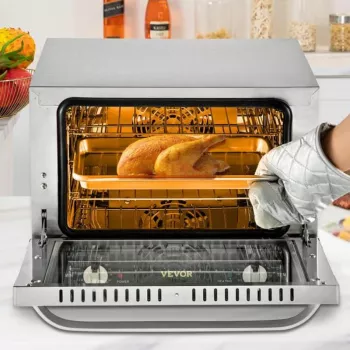
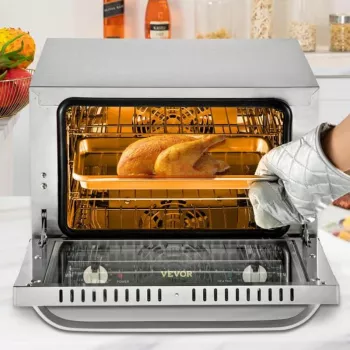
A countertop convection oven with multi-layer baking capacity can speed up weeknight meals, improve browning, and handle batch baking in a smaller footprint than a full-size range. If you’re choosing between 21L, 47L, and 66L sizes, the best pick comes down to pan size, how often you bake, and whether you plan to run 3–4 racks at once. Below is a clear breakdown of how convection works, when multi-layer baking shines, and the day-to-day details that make results more consistent.
Convection ovens use a fan to move hot air around the cavity. That steady airflow changes how heat reaches food, which is why many recipes brown faster and more evenly than in non-fan toaster ovens.
Capacity isn’t just about “more is better.” Larger ovens tend to give you more vertical spacing between racks (helpful for airflow), while smaller ovens save counter space and handle everyday tasks efficiently.
| Capacity option | Best for | Typical multi-layer approach | Notes on counter space |
|---|---|---|---|
| 21L | Quick snacks, small bakes, reheating, single-pan dinners | 1–2 racks for best airflow; rotate if baking longer than 15–20 minutes | Most compact footprint; easiest to store or keep on the counter |
| 47L | Family meals, batch sides, more frequent baking | 2–3 racks; stagger trays and rotate positions for even color | Balanced size; check cabinet clearance for heat and ventilation |
| 66L | Meal prep, entertaining, multi-tray baking sessions | 3–4 racks; ideal for cookies/pastries when rotated mid-bake | Largest footprint; plan a dedicated, ventilated counter location |
As a rule, multi-layer baking works best when there’s enough space between racks for air to circulate. If you routinely bake several trays at once (cookies, roasted vegetables, appetizers), the roomier 47L or 66L options make it easier to avoid “blocked airflow” zones that can cause uneven browning.
Multi-layer baking is most successful with foods that tolerate airflow and don’t rely on a delicate rise. Great candidates for 3–4 layers include:
Skip tightly packed, tall dishes on adjacent racks. When a casserole or loaf pan sits too close to the rack above it, it blocks circulation and can lead to pale tops and uneven cooking.
For better airflow, stagger trays so they don’t line up perfectly. If the front edge of one pan sits directly beneath the front edge of another, it can create a “wall” that the fan has to work around.
For bakes longer than about 15–20 minutes, rotate once: move the top tray to the bottom, the bottom to the top, and swap front-to-back if your oven layout allows. This one step often makes the difference between “mostly even” and “consistently even.”
For safe internal temperatures, use a trusted reference like the USDA safe minimum internal temperature chart. For energy and cooking efficiency tips, the U.S. Department of Energy’s cooking guidance is also helpful when deciding when to use a smaller countertop oven versus a full-size range.
If you want one unit that scales from quick weeknight meals to batch baking, the Electric Convection Oven, 21L/47L/66L, Countertop 3-4 Layer Baking Machine is offered in multiple capacities to match your space and how often you cook. It’s built for multi-layer workflows (3–4 layers), making it a practical choice for cookies, roasted vegetables, meal prep, and reheating when a full-size oven feels slow or unnecessary.
Yes—circulating air improves heat transfer, so foods often finish sooner and brown more quickly. Start checking early and adjust time or temperature gradually for recipes written for conventional ovens.
Yes, especially for cookies, pastries, and roasted vegetables. Leave airflow gaps, stagger pans so they don’t line up directly, and rotate rack positions once during longer bakes for even browning.
21L is usually the easiest fit for limited counter space and single-tray cooking, while 47L is a balanced option if you bake more often. Choose 66L if you frequently batch-bake on multiple racks and have a dedicated, well-ventilated spot for a larger appliance.


Leave a comment