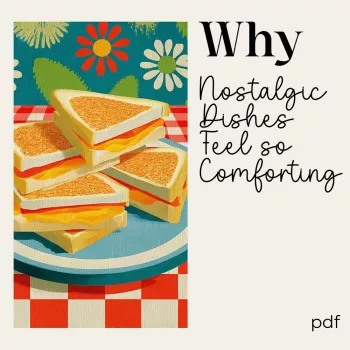
Some meals do more than fill a plate—they bring back places, people, and calmer versions of everyday life. Nostalgic dishes often feel comforting because they’re familiar, predictable, and tied to meaningful memories. When life feels noisy, a “known” bowl of soup or a classic baked pasta can feel like a soft landing: the flavors make sense, the steps are familiar, and the moment is easy to repeat.
That comfort isn’t just sentimental—it’s sensory. Smell, in particular, is strongly linked to memory and emotion, which helps explain why a buttery toast aroma or a pot of onions and garlic can feel instantly grounding (see Harvard Health Publishing and this overview of the olfactory system). Add the everyday reality of stress—when the body is on high alert, simple routines and predictable meals can feel especially stabilizing (American Psychological Association: stress effects on the body).
Nostalgic comfort food usually isn’t about complexity. It’s about cues that signal “safe,” “familiar,” and “I know what happens next.”
| Comfort cue | Why it feels good | Easy way to add it tonight |
|---|---|---|
| Warm, creamy textures | Signals richness and ease; feels soothing | Add a simple sauce, a splash of milk, or a dollop of yogurt/sour cream |
| Slow-simmered aroma | Smell is strongly linked to memory and emotion | Sauté onions/garlic first; simmer soup or sauce for 15–20 minutes |
| Crisp edges + soft center | Texture contrast increases satisfaction | Toast bread; broil a casserole top; pan-sear dumplings or potatoes |
| A signature spice | One recognizable note can unlock a whole memory | Use cinnamon, nutmeg, dill, paprika, or vanilla in a small, consistent amount |
| Familiar serving style | Presentation becomes part of the ritual | Use the same bowl/plate; serve family-style; add a simple garnish |
Classic comfort food tends to work because it aligns with how real life feels on tired days: it’s straightforward, forgiving, and dependable.
Use this as a quick build-your-own template. The goal isn’t perfection—it’s repeatability.
If you like having a printable, repeatable plan, this guide is designed to make comfort meals feel automatic: Why Nostalgic Dishes Feel so Comforting | Nostalgic Meal Checklist | Cozy Kitchen Guide (Instant Digital Download).
And if part of “cozy” means a small, cheerful ritual beyond the plate—like dressing up a simple outfit for a grocery run—consider a tiny treat item such as 18K Gold Plated Daisy Drop Earrings.
Familiar foods reduce uncertainty: the flavor outcome is predictable, and that can feel calming when you’re tired or stressed. Smell and taste also connect strongly to memory, so even a basic aroma—like toasted bread or cinnamon—can quickly bring back a sense of safety.
Try a gentler variation that keeps the comforting element (like the same spice or serving ritual) without copying the exact dish. You can also build a new tradition using similar flavors, so the meal becomes associated with your current life instead of the past.
Keep a short rotation of dependable meals, stock a few pantry/freezer staples, and lean on one-pot or bake-and-walk-away methods. Planning leftovers on purpose makes the next day easier without adding more cooking time.







Leave a comment