Turn “Maybe” Ideas Into a Clear Business Direction
Good ideas are everywhere—notes apps, group chats, late-night “what if” moments. The hard part is choosing one direction with enough confidence to take the next step without wasting months building the wrong thing.
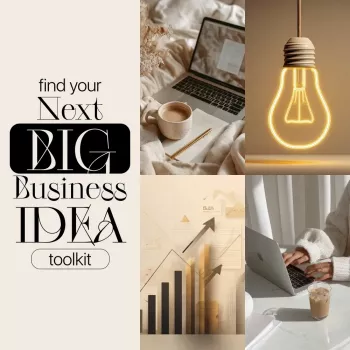
The Find Your Next Big Business Idea Toolkit – Trendspotting, Market Gaps, Validation, MVP Tests & Idea Scorecard (Ebook) is a practical, structured toolkit designed to help you spot real demand signals, uncover profitable gaps, validate willingness-to-pay, run lightweight MVP tests, and score options so your best idea rises to the top with less guesswork.
Who This Toolkit Helps (and When to Use It)
- Aspiring founders with many ideas but no confident “next step”
- Side-hustle builders who want to reduce risk before investing money or quitting a job
- Creators, consultants, and freelancers ready to productize an offer
- Early-stage startups choosing between multiple niches, audiences, or problem spaces
- Best moments to use it: before domain/logo decisions, before building features, before pricing debates, and before hiring
When decisions still feel reversible, this process is at its strongest—because small tests can save big time.
What’s Inside the Ebook Toolkit
- Trendspotting framework to identify rising demand and shifts in behavior
- Market gap finder to map competitors and locate underserved segments
- Validation checklists to test willingness-to-pay and urgency
- MVP test menu with low-cost experiments that can run in days, not months
- Idea scorecard to compare options on desirability, feasibility, and viability
- Repeatable workflow you can reuse for future ideas or pivots
Trendspotting Without Chasing Hype
Trendspotting isn’t about copying whatever looks popular this week. It’s about collecting signals that suggest durable behavior changes—and translating them into testable hypotheses.
- Start with signals that reflect real behavior: search patterns, community discussions, tool adoption, and purchasing shifts (for example, using Google Trends to compare interest over time).
- Differentiate short-lived novelty from persistent pain points that intensify as the world changes.
- Look for “adjacent moves”: industries borrowing solutions from other industries (think: subscription models moving into new categories).
- Use constraints to focus: pick a customer type, a job-to-be-done, and a context (remote work, aging, compliance, creator economy, and so on).
- Document trends as hypotheses: what changed, who it affects, and what new demand emerges.
This helps you move from “I’ve got a cool idea” to “Here’s the shift, here’s who it hits, and here’s the outcome they’ll pay for.”
Finding Market Gaps That Are Actually Profitable
A “gap” becomes profitable when it connects to a specific audience, a real constraint, and a clear promise. The toolkit pushes you to map the space beyond obvious competitors so you can see what buyers do when they don’t buy from incumbents.
- Map the space: direct competitors, substitutes, and DIY alternatives.
- Identify gaps by customer segment (beginners vs. experts), use case (speed vs. quality), or channel (mobile-first vs. desktop-heavy).
- Watch for over-served areas: bloated features, confusing onboarding, and pricing that feels misaligned.
- Spot neglected constraints: compliance, integrations, accessibility, localization, offline use, or reliability.
- Translate gaps into a clear promise: a specific outcome for a specific audience under specific conditions.
Quick Market Gap Map
| Lens |
Questions to Ask |
Example Outputs |
| Audience segment |
Who is ignored or talked down to? |
Non-technical teams, bilingual customers, small operators |
| Use case |
Which tasks are too slow, risky, or confusing? |
Faster onboarding, simpler reporting, fewer steps to purchase |
| Pricing & packaging |
What feels unfair or mismatched? |
Pay-per-use, starter tiers, clear bundles, transparent limits |
| Channel & distribution |
Where do buyers hang out, and who isn’t reaching them? |
Community partnerships, affiliates, niche marketplaces |
| Constraints |
What “must-have” requirements are unmet? |
Compliance, integrations, accessibility, offline-first |
For a practical baseline on research and competitive analysis, the SBA’s guide is a strong reference: SBA — Market Research and Competitive Analysis.
Validation: Proof Before Building
Validation is about reducing uncertainty in the fastest, cheapest way. Instead of debating endlessly, you define what you need to learn, then collect evidence in layers.
- Define the riskiest assumption: problem severity, willingness-to-pay, or ability to reach buyers.
- Collect evidence in layers: qualitative (interviews) + behavioral (clicks, signups) + transactional (preorders, deposits).
- Ask questions that reveal urgency: what they tried, what it cost, and what breaks if it isn’t solved.
- Set a simple threshold for “enough validation” before running tests (X signups, Y replies, Z preorders).
- Avoid false positives: compliments, vague interest, and “cool idea” feedback without commitment.
MVP Tests That Minimize Time and Cost
For a clear explanation of MVP thinking, Strategyzer offers a helpful primer: Strategyzer — The Minimum Viable Product (MVP).
Using an Idea Scorecard to Choose the Best Option
A Simple 7-Day Workflow to Go From Idea to Confident Next Step
Common Pitfalls This Toolkit Helps Prevent
Product Details and What to Expect
Recommended Picks (In Stock)
FAQ
How long does it take to validate a business idea using this toolkit?
A fast round of validation can take a weekend (interviews plus a simple landing page), while stronger proof—like pre-sells or multiple test cycles—often takes a few weeks. The key is setting pass/fail criteria upfront so you can make a decision quickly.
Do MVP tests require coding or a full product build?
No. Many effective MVP tests are low-build or no-code, such as concierge delivery, clickable prototypes, landing pages, or smoke tests. The goal is learning and commitment signals, not feature completeness.
What is an idea scorecard and how is it used?
An idea scorecard is a structured rubric that compares ideas across desirability, feasibility, viability, and risk. Score a shortlist of 3–5 ideas using the same criteria, then choose the next experiment based on totals and the evidence you collected.
Recommended for you






Leave a comment