
Emotional strength isn’t about avoiding stress, staying positive all the time, or “winning” difficult moments. It’s the ability to recover faster after setbacks, think more clearly under pressure, and respond with intention instead of impulse. Used thoughtfully, AI can act like a structured companion for that process—helping you name emotions, spot patterns, rehearse healthier responses, and keep small daily practices consistent.
The goal is not to replace human support. It’s to add practical, repeatable tools that make emotional growth easier to start and more sustainable over time. For a research-backed view of resilience and coping, the American Psychological Association and the National Institute of Mental Health both emphasize skills like flexible thinking, supportive routines, and self-care behaviors—areas where AI can help you practice consistently.
Most people build resilience in ordinary moments: the email that spikes anxiety, the awkward conversation, the parenting stress, the uncertainty that lingers. Everyday emotional strength often shows up as:
AI works best as a “practice space”—a place to reflect, draft healthier scripts, and build consistency. A few guardrails help keep it supportive and realistic.
| Goal | Helpful approach | Unhelpful approach |
|---|---|---|
| Calm down after stress | Ask for a 2-minute grounding routine and a short self-talk script | Ask for reassurance loops or avoid the situation indefinitely |
| Understand emotions | Request emotion-labeling help and a values check | Ask AI to judge who is “right” and escalate conflict |
| Improve communication | Role-play a respectful message and boundary statement | Use AI to craft manipulative or passive-aggressive replies |
| Build habits | Create a simple daily plan with reminders and check-ins | Overbuild a complex routine that becomes impossible to sustain |
A daily routine doesn’t need to be deep or time-consuming to be effective. The most useful structure is short, repeatable, and focused on a next step you can actually do today.
Describe the situation in neutral facts (no mind-reading, no conclusions). Then identify the primary emotion (anxious, sad, irritated, ashamed, etc.). If needed, ask AI for help labeling the feeling based on your description.
Ask AI to list possible triggers, thoughts, and body signals. Choose the ones that feel most accurate. This turns a vague “I’m overwhelmed” into something workable: “My chest is tight, I’m telling myself I’ll fail, and I didn’t sleep enough.”
Generate three balanced interpretations, then pick one that feels realistic (not overly positive). The goal is mental flexibility, not forced optimism.
Pick one small behavior aligned with values: repair, rest, ask for help, set a boundary, take a walk, or do the first two minutes of a task you’re avoiding.
Rate emotional intensity before/after (0–10) and note what helped. Over time, this creates a personal “what works for me” library.
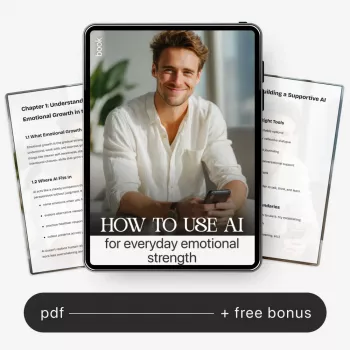
If a structured approach would help, consider How to Use AI for Everyday Emotional Strength: Practical eBook with AI Suggestions for Emotional Growth. For small confidence boosts that support “showing up” on hard days, 18K Gold Plated Daisy Drop Earrings can be an easy, everyday finishing touch, and Ermanno Scervino Slim Fit Blue Jeans can help simplify getting dressed when decision fatigue is high.
Yes—AI can support reflection, skills practice, and habit consistency, but it can’t diagnose conditions or replace a licensed professional. For persistent, severe, or worsening symptoms, professional support is the safest next step.
Avoid relying on AI for crisis situations, feeding reassurance spirals, oversharing sensitive personal data, using AI to “win” arguments, or treating outputs as absolute instructions. Use privacy-friendly details and treat suggestions as options you can accept, edit, or decline.
Use a 5–7 minute routine: name the emotion, do one grounding step, choose one balanced reframe, and take one values-based action. Consistency matters more than intensity, so keep it simple enough to repeat daily.



Leave a comment