
Second-guessing can turn even small choices into a drain on time, energy, and self-esteem. Building self-trust is less about being “right” all the time and more about using a repeatable process—so choices feel clearer, values stay centered, and setbacks become feedback instead of proof of failure. With the right structure, uncertainty stops feeling like an emergency and starts feeling like a normal part of life that can be managed.
Confidence tends to wobble when decisions feel high-stakes, when information is endless, or when approval from others quietly becomes the goal. The good news: self-trust isn’t a personality trait you either have or don’t have—it’s a skill that strengthens through small, consistent actions.
Self-trust is the ability to make a choice, act on it, and stay grounded even when outcomes are mixed. It’s not blind positivity, and it’s not pretending doubt doesn’t exist. It’s the inner stability that says, “I can handle what comes next.”
Real confidence grows from evidence—small promises kept, lessons learned, and values followed consistently. That evidence can be practical (you followed through) and emotional (you regulated stress and recovered after a setback). This is closely related to self-efficacy, the belief that you can take effective action; it’s widely discussed in psychology and defined in the APA Dictionary of Psychology.
Healthy self-trust also includes flexibility. Changing course isn’t a “gotcha” that proves you were wrong; it’s a strength when new information appears. A helpful mindset shift is aiming for “good decisions with good reasons,” rather than “guaranteed results.” Life is complex, and many outcomes are partly outside your control—what can be controlled is the quality of your process.
If decisions regularly feel heavy, it’s often because a few predictable patterns are running in the background.
Replaying options can feel responsible, but it often becomes a way to avoid regret. Ironically, rumination tends to increase anxiety rather than improve clarity.
When approval becomes the measuring stick, personal needs and values get blurry. The “right” decision starts meaning “the one that won’t upset anyone,” which is rarely sustainable.
Believing one wrong move “ruins everything” inflates the stakes. Most decisions are adjustable, reversible, or recoverable with a course correction.
Avoiding decisions to avoid discomfort quietly trains the brain to doubt its coping ability. Avoidance feels like relief, but it can shrink confidence over time.
Too many daily micro-choices reduce willpower and make later decisions feel heavier. The American Psychological Association describes how self-control and mental energy can get depleted over the day, which can contribute to decision fatigue and lower-quality choices (APA: Willpower (self-control)).
When choices feel chaotic, a framework acts like a handrail. The goal isn’t to remove emotion—it’s to reduce noise so the decision becomes workable.
3) Gather “just enough” evidence. Set a short time box to research, then stop collecting information. This respects the reality of bounded rationality: humans make decisions with limited time, attention, and knowledge, not perfect data (Stanford Encyclopedia of Philosophy: Bounded Rationality).
| Checkpoint | Quick prompt | Green flag (ready to decide) |
|---|---|---|
| Clarity | What is the decision in one sentence? | The choice is specific and time-bound |
| Values | Which value(s) must be honored? | The option supports at least one core value |
| Evidence | What do the facts say? What is assumed? | Key facts are known; assumptions are labeled |
| Options | What are 2–3 realistic paths? | At least one option is low-risk to try first |
| Cost of waiting | What happens if nothing changes? | Waiting has a clear downside, not just comfort |
| Support | Who/what helps execution? | One support is identified (tool, person, plan) |
| Next step | What is the first 10-minute action? | A concrete first step is scheduled |
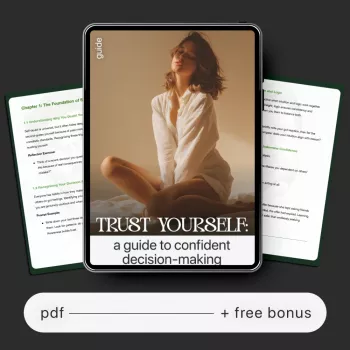
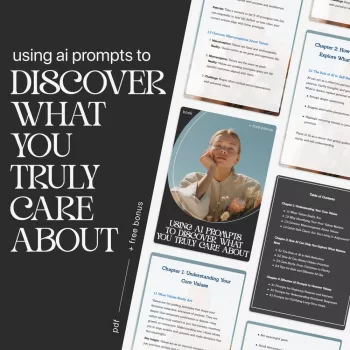
If you prefer actionable exercises over theory-heavy reading, a structured workbook can help you move from “thinking about it” to “doing the next small step.” For a focused option, consider Trust Yourself: A Guide to Confident Decision-Making (digital PDF download).
To support the “small wins” approach in everyday life, it can also help to practice making quick, values-based choices with low-stakes purchases—like choosing a simple personal accessory such as 18K Gold Plated Daisy Drop Earrings, or committing to a wardrobe upgrade like Ermanno Scervino Slim Fit Blue Jeans. Even home projects can become a confidence practice when you use a checklist and take one step at a time, such as planning measurements and installation for a Golden Ceramic Round Bathroom Sink.
Self-trust reduces rumination by making your process more consistent: you clarify priorities, choose based on values and evidence, and follow through. Instead of chasing perfect certainty, you learn from outcomes and adjust without losing your footing.
Review the reasons you chose what you did, extract one or two lessons, and decide on a specific adjustment or next step. A good decision can still lead to an unfavorable outcome, so avoid global conclusions about your worth or competence.
Free journaling is flexible and expressive, while a workbook provides prompts, consistency, and a repeatable process—often more helpful for overthinkers who want structure. Many people use both: a workbook for decisions and journaling for emotional processing.




Leave a comment